Jito restaking vaults, liquid receipt tokens and redemption
Updated onJito restaking lets Solana vaults mint liquid vault receipt tokens (VRTs) for deposits of supported tokens. The receipt carries a share of the issuing vault's assets while administrators manage delegation to operators serving node consensus networks (NCNs). Its token quantity need not equal the deposited quantity because share pricing and fees govern minting. Transferring or trading the receipt changes who holds that claim; redeeming it through the vault follows a separate withdrawal process.
Minting receipts and buying an existing vault claim
A deposit matching the vault's configured asset and mint conditions transfers the accepted token and issues its VRT. If its preview shows fewer receipts than the input token quantity, compare their underlying value.
The expected output follows the vault's share calculation after its deposit fee. Review the refreshed quote and the transaction's minimum VRT output before signing. The core mint instruction fails if its output after fees falls below that minimum. Buying an existing VRT provides another entry route where a suitable market exists. Minting uses vault pricing and deposit fees; a purchase uses market pricing and trading costs. For a fixed deposit amount, if share pricing and the market quote stay unchanged, a higher deposit fee can reduce the receipts minting delivers. When it does, the unchanged purchase quote compares more favorably, provided its liquidity supports the intended trade.
| Action | Effect on the vault claim | Asset or access required |
|---|---|---|
| Deposit and mint VRT | Creates additional vault shares | Accepted token, deposit capacity and mint access |
| Buy an existing VRT | Acquires shares from another holder | A trading market with liquidity for the exact VRT |
| Hold VRT | Retains the vault position | Control of the VRT balance |
| Transfer VRT | Moves receipts to another wallet | Authority to spend the available VRT balance |
| Use VRT in DeFi | Places receipts under application-specific conditions | An application supporting the exact VRT mint |
| Redeem through the vault | Exchanges redeeming shares for underlying assets | The vault's VRT, a mature withdrawal ticket and settlement access |
After either transaction is confirmed, its VRT credit identifies the amount actually received, and the mint must match the intended vault. A displayed quote or signed transaction alone does not establish that the deposit or trade succeeded.
Reconciliation also differs between the routes. A mint's receipt credit should match the vault calculation after its deposit fee. A purchase's credit should match the trade's executed output. If a submitted transaction's status remains unresolved, determine whether it completed before submitting the same action again.
Accepted deposit assets and the vault's accounting token
The core vault deposit requires its configured Solana Program Library (SPL) token mint, even when an interface displays additional entry choices.
The configured underlying token
Each core vault records an accepted token mint and a separate VRT mint. The deposit instruction validates matching token accounts against those records. A vault accepting JitoSOL prices its shares in JitoSOL units. Another vault accepting a different token has its own accounting basis and receipt identity.
Assets shown by an interface
The restaking interface offers asset-first and vault-first selection, with an entry menu including SOL alongside tokenized assets. Those entry choices belong to the interface or strategy, while direct minting validates the core vault's configured token. The receipt's underlying asset remains relevant even when the interface starts from another wallet asset.
What determines the underlying amount each VRT represents?
A VRT represents a proportional claim on the assets held by its issuing vault. The conversion uses accounted underlying assets and outstanding receipt supply. Deposits mint proportional shares, with the depositor receiving the amount left after the deposit fee. Integer arithmetic introduces rounding at the token's smallest units. Net rewards can raise assets per receipt without increasing the holder's VRT balance. With a liquid staking token as collateral, base staking accrual belongs to that underlying token's economics. NCN rewards add another potential return at the vault level, with availability governed by supported services and network reward rules.
Delegation links and the operator's service obligations
Active NCN stake requires approved links between the vault, operator and network, plus an actual delegation.
Vault allocation
A deposit creates a vault position without automatically activating stake for every service the vault supports. The vault's delegation authority allocates assets to operators. Mutual opt-in records connect the participants, with activation and cooldown states. An administrator or governance process can direct allocations within the vault's configured permissions.
The operator's service
Operators run the work an NCN defines and can serve several networks. TipRouter operator software performs tip-routing calculations and submits results for its network. Delegated stake supports those services without giving the operator direct custody of the vault's deposited tokens. Service performance and NCN economic rules determine associated reward eligibility. Networks can share supporting stake, so several approved relationships need not correspond to separate pools of deposited assets.
Slashing status and the limits of a liquid receipt
The published core Vault Program stores slasher relationship records but has no instruction that executes slashing. A particular vault or NCN's live penalty rules cannot be determined from those records alone. A liquid receipt still carries exposure to vault software and the underlying strategy. Further DeFi use adds the receiving application's own rules and risks. Transferability does not establish a fixed redemption value or an available market buyer.
Withdrawal tickets, epoch maturity and the final claim
A withdrawal ticket meets its timing requirement after the request's restaking epoch and the next full epoch have ended. The program derives those epochs from its configured slot length. Elapsed time therefore depends on where the request falls within the epoch and how slots progress.
Receipts held for the pending withdrawal
Enqueuing transfers the selected VRT amount into the withdrawal ticket's token account. Those receipts are no longer freely transferable from the depositor's account. The ticket records the VRT quantity and request slot, rather than fixing an underlying payout. The standard withdrawal route has no cancellation step.
A partial withdrawal can leave the unqueued balance available for other uses, while the pending portion remains governed by its ticket. Initiation creates the pending request; it does not itself return underlying assets. Final redemption requires a subsequent claim instruction.
Settlement conditions and the receiving asset
Maturity alone does not complete the claim. Vault state must be current, enough underlying assets must be withdrawable and the vault must permit the operation. Any configured mint/burn signer also remains relevant. Settlement allocates withdrawal fees denominated in VRT, burns the redeeming portion and transfers the calculated underlying amount.
The destination token account must match the vault's underlying mint and the ticket's recorded owner. Redemption from a core vault backed by JitoSOL returns JitoSOL. Converting that asset into SOL involves another operation with its own conditions. The final claim amount follows vault accounting and applicable fees at settlement.
Fees, receipt supply and the net position
Deposit, reward and withdrawal fees affect different parts of the position, and administrators can change configured fee settings. The deposit fee reduces VRT delivered to the depositor. Reward-fee accounting can mint VRT to the vault fee wallet, increasing receipt supply. Withdrawal settlement separates vault and program fees from the amount actually burned.
These charges differ from Solana transaction fees, paid in SOL. NCNs and operators can apply their own reward economics. A reward percentage, a deposit percentage and a trading quote therefore measure different costs. The total effect depends on the chosen vault, reward flows and exit method. The applicable configuration matters for each operation; one route's displayed rate does not describe every way to acquire or release a receipt.
DeFi acceptance and a market exit
An external application must explicitly accept the exact VRT mint before its lending, collateral or liquidity features apply. Support for an underlying asset does not automatically extend to every receipt representing it. Using VRTs elsewhere adds the application's borrowing, liquidation or liquidity conditions where those functions apply. The vault position and the receiving application's position remain distinct.
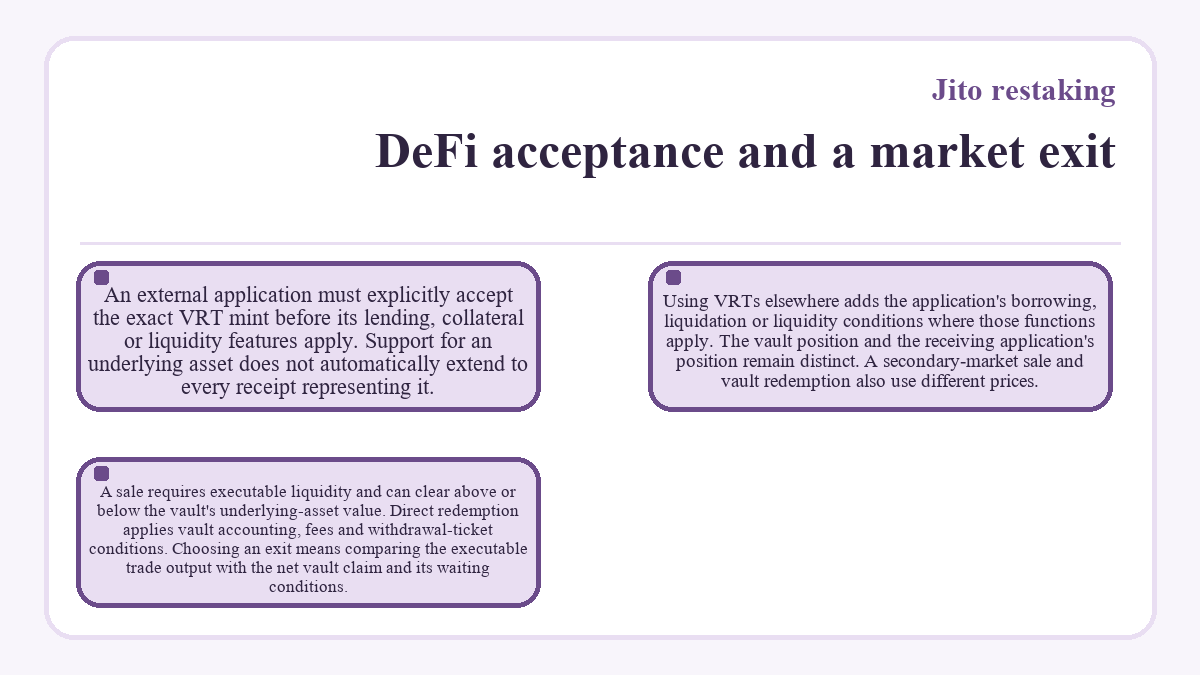
A secondary-market sale and vault redemption also use different prices. A sale requires executable liquidity and can clear above or below the vault's underlying-asset value. Direct redemption applies vault accounting, fees and withdrawal-ticket conditions. Choosing an exit means comparing the executable trade output with the net vault claim and its waiting conditions.
Jito restaking: frequently asked questions
Can I mint a VRT by sending tokens straight to the vault address?
A direct token transfer does not execute the vault's VRT mint instruction. Minting validates the accepted asset, receipt mint and required accounts before transferring the deposit and issuing shares. Sending tokens to a vault token account outside that operation can add assets without creating receipts for the sender.
Does a Token-2022 asset work with the core vault mint instruction?
The core Vault Program's mint instruction validates the original SPL Token Program. A Token-2022 asset therefore does not satisfy that direct-deposit path merely because it is a Solana token. Any adapter offering additional token types needs its own conversion and compatibility rules; the underlying vault instruction retains its token-program requirement.
Why might a vault mint require another signer?
A vault can configure a mint/burn administrator whose signature is required for minting and withdrawal operations. The depositor's signature alone then cannot satisfy the core instruction's authorization checks. This requirement belongs to the selected vault's configuration, so wallet connection or token ownership does not establish unrestricted mint access.
Are VRTs from different vaults interchangeable when they accept the same asset?
Each VRT mint identifies its issuing vault, even when several vaults accept the same underlying token. Their receipt supplies, fees and delegation arrangements can differ. A redemption request must use the receipt mint recorded by the selected vault; a matching underlying asset does not make another vault's receipts valid for that claim.
What happens if I send extra VRT to an existing withdrawal ticket?
Extra VRT does not increase the ticket's recorded withdrawal amount. At settlement, the core withdrawal instruction sends any surplus in the ticket's token account to the program fee wallet. The request size comes from the VRT quantity stored when the ticket was created, so topping up that account does not enlarge the claim.
Is it possible to move a pending vault withdrawal to another wallet?
The core program supports changing a withdrawal ticket's recorded owner with authorization from its existing owner. That operation changes the claim recipient without changing the recorded VRT amount or request slot. The vault's pause state also applies. It requires a client able to call the ticket-owner instruction; ordinary receipt transfers leave ticket ownership unchanged.
Are vault deposits and withdrawal tickets private?
Vault deposits and withdrawal tickets leave public onchain records on Solana. Token accounts expose receipt balances, while a withdrawal ticket records its vault, owner, VRT quantity and request slot. These records can reveal wallet activity without identifying a person's legal name. Signing through a wallet does not make those account fields confidential.