Jito token roles and JTO voting rights
Updated onJito uses JTO as the governance token of its decentralized autonomous organization (DAO), giving holders voting power over protocol fees, treasury allocations and other authorized changes. Depositing JTO through Realms registers that power for proposals, and holders can delegate voting authority. JitoSOL represents a liquid staking position instead. Governance authority applies within DAO-controlled permissions, so a token balance alone does not imply control over every network operation.
A holder evaluating a fee proposal needs to separate the right to vote from the staking position affected by the decision. The same separation applies to treasury revenue: controlling its allocation does not automatically pay it to a holder.
Delegating JTO voting power lets a representative vote on DAO proposals while token ownership stays with the depositor.
JTO and JitoSOL serve different token roles
JTO connects a holder to DAO decision-making, while JitoSOL represents a share of staked SOL and accumulated rewards in the stake pool. Native SOL is the underlying asset delegated to Solana validators. JTO voting does not itself delegate SOL to validators. The JitoSOL exchange rate reflects the pool's assets relative to its token supply. Registered JTO voting power expresses influence on DAO proposals rather than the value of a staking position. A protocol fee can influence both the staking product's net rewards and the assets reaching the DAO treasury.
Which decisions belong to JTO governance?
JTO governance covers DAO-controlled treasury spending, protocol settings and changes to the network's governance arrangements, subject to the permissions and procedures attached to each decision. A Jito Improvement Proposal, or JIP, describes the requested change and its implementation. Its category identifies the decision's subject; its execution path identifies how the approved change would happen.
Fees and staking parameters
Fee governance includes the JitoSOL stake pool and the restaking network. StakeNet uses program parameters to manage validator selection and stake allocation. TipRouter has its own network parameters. These are separate control surfaces, even when their effects reach the same staking economy. A change to stake-pool fees affects that product's economics; a technical adjustment to validator scoring affects how the pool delegates.
Treasury allocations
Treasury proposals determine how DAO assets support development or other approved spending. The treasury can hold JTO alongside assets received from protocol fees. A treasury proposal can spend JTO or another asset, while JTO governance deposits supply voting power. A proposal spending fee revenue does not need to transfer JTO to accomplish its purpose. Its recipient, asset and approved amount define the allocation.
Governance bodies and delegated permissions
The framework adopted through JIP-35 assigns scoped technical responsibilities to a Dev Council. That allows operational stake-pool management within its delegated permissions. Tokenholders retain authority to revoke those permissions through the JIP process. Consequently, DAO control can coexist with technical actions performed by an authorized council. Its assigned program authority does not include lasting authority over user funds.
Delegating program permissions differs from delegating a holder's ballot. The former grants authority to maintain specified components. The latter lets a representative vote with an owner's governance power. The scope of each grant determines which actions its recipient can take. A DAO-approved mandate can therefore support routine operations without asking holders to vote on every parameter adjustment.
How do governance deposits and delegation differ?
A deposit registers JTO for governance, while delegation changes who can use that registered voting power under the DAO's proposal rules.
Deposited JTO and the governance record
Realms keeps a token-owner record associated with the deposited governance token and its owner. Depositing JTO through Realms gives the holder token voting power in the DAO. The recorded deposit differs from the balance available for ordinary transfers. This arrangement ties a ballot to eligible governance tokens and an authorized signer. Voting power contributes to a collective tally; passage still requires the proposal to meet its configured approval rules.
A delegate's authority
A governance delegate receives permission to vote using the owner's recorded power. Token ownership remains with the depositor. Realms assigns a delegate to the token-owner record, so sending JTO to the delegate's personal wallet is a different action. The delegate's voting history and stated positions help explain how that authority has been used. The depositor can still vote directly after appointing a delegate.
Treasury revenue and JTO buybacks
The DAO treasury receives revenue generated by protocol activity. That revenue can fund approved buybacks, development grants or network incentives. Buybacks purchase JTO; burns remove acquired tokens from circulation. Neither distributes tokens directly to every holder. JIP-38 commits the DAO's share of JTX platform fees to buybacks and burns from JTX launch through the Q4 2027 re-appraisal, for at least one year. Redirecting that revenue during the term requires a standalone JIP. A governance deposit does not create an automatic payout.
Choosing JTO voting power or a JitoSOL position
A decision about DAO spending calls for governance authority. A position representing staked SOL calls for JitoSOL.
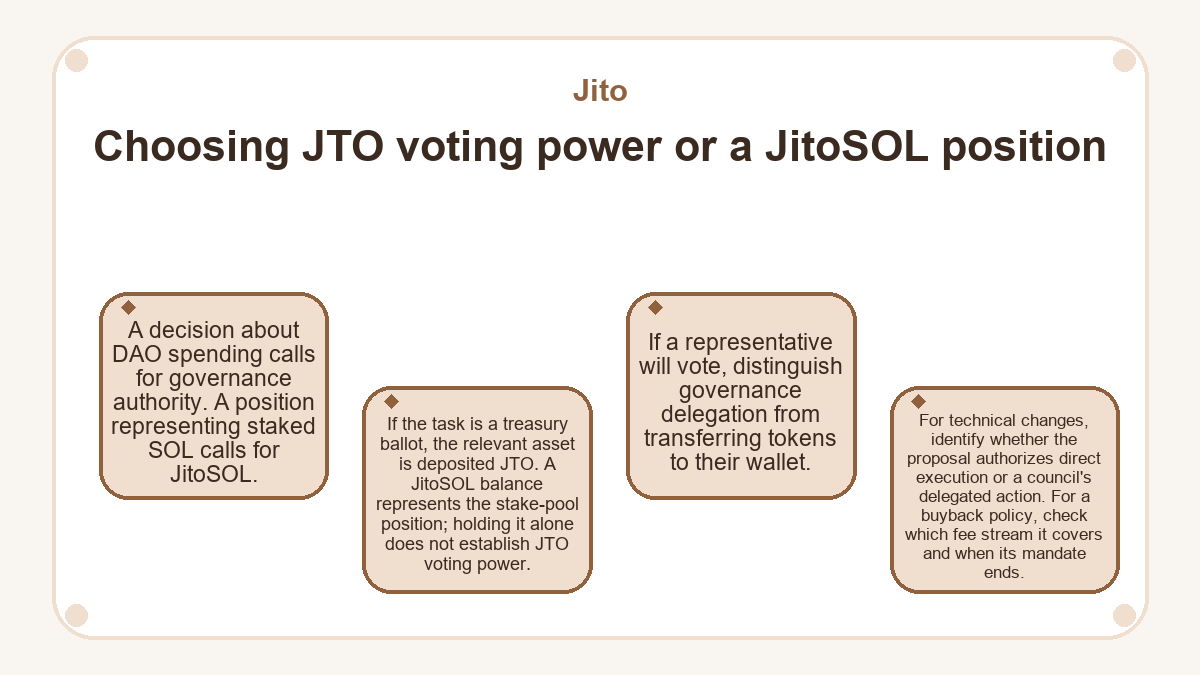
- If the task is a treasury ballot, the relevant asset is deposited JTO.
- A JitoSOL balance represents the stake-pool position; holding it alone does not establish JTO voting power.
- If a representative will vote, distinguish governance delegation from transferring tokens to their wallet.
- For technical changes, identify whether the proposal authorizes direct execution or a council's delegated action.
- For a buyback policy, check which fee stream it covers and when its mandate ends.
Does approval immediately implement a JTO proposal?
Approval establishes the DAO's decision, while implementation follows the proposal's execution path, any required delay and the permissions needed to carry out the change.
Attached on-chain actions
An executable proposal can contain instructions for a treasury transfer or a program change. Passing the ballot permits those instructions to execute under the configured rules. The attached instructions identify the asset moved, recipient account or parameter being changed. The governance program tracks execution separately from voting success. A proposal still requiring a transaction has not completed that action merely because its vote succeeded. Proposal-specific timing follows the active governance configuration, including any hold-up period attached to execution.
Foundation and council responsibilities
Other proposals require contributor work, Foundation actions or execution by an authorized council. JIP-35 distinguishes the Dev Council's operational role from the Security Council's security responsibilities. Delegated management allows specified technical work to proceed within a mandate. The DAO can govern that mandate without treating every maintenance operation as a new public ballot. Implementation can also depend on obligations the Foundation must satisfy beyond the on-chain vote.
An on-chain treasury allocation can finish with execution of its approved transfer. A grant requiring software delivery also depends on the contributor meeting that obligation beyond the funding decision.
Useful questions about Jito
-
Can JTO kept on a custodial exchange count toward my wallet's DAO vote?
- A custodial exchange balance does not automatically create voting power for your personal wallet. Realms recognizes deposited governance tokens and their token-owner records. Your exchange account's displayed JTO balance is a separate record maintained by the custodian. Any voting or delegation arrangement the custodian offers must connect to the DAO's actual governance authority; an account balance alone establishes no ballot from your wallet.
-
Are JTO governance ballots private?
- JTO ballots cast through Realms are recorded on Solana. The governance program stores the proposal, token owner, voting weight and vote choice in its on-chain records. These records make the ballot inspectable. A wallet address does not necessarily reveal a person's identity, but the voting mechanism does not make the associated on-chain activity a secret ballot.
-
Can I replace the wallet voting as my JTO delegate?
- Realms supports changing or revoking a governance delegate. The change updates the authority associated with the token-owner record while leaving token ownership with the depositor. The record designates one delegate, so this delegation mechanism does not split the same record's voting power across several representatives. Replacing a delegate does not erase the on-chain history of votes already cast.
-
What can block withdrawal of JTO deposited for governance?
- Vote or proposal obligations attached to the governance deposit can block withdrawal. The token-owner record tracks unrelinquished votes and outstanding proposals, which the program checks before allowing tokens to leave governance. These conditions concern participation in DAO decisions. They differ from SOL stake deactivation, so a Solana staking epoch is not the governing measure for releasing a JTO deposit.
-
Does a forum poll have the same effect as a JTO vote in Realms?
- A forum poll does not substitute for a formal DAO vote in Realms. Forum discussion develops proposals and gathers feedback, while the governance portal records token-weighted ballots and supports proposal execution. A discussion showing strong support can influence a proposal's development. It does not, by itself, authorize a treasury transfer or alter an on-chain protocol parameter.
-
Is the JTO balance needed to submit a proposal also required to cast a vote?
- Proposal submission and voting use separate governance requirements. A proposal-creation threshold controls who can introduce an on-chain proposal; it is not a general minimum balance every voter must hold. Voting instead uses eligible governance power and the authority to cast a ballot. The applicable submission threshold comes from the active governance configuration and can change through governance.