Jito liquid staking and Solana transaction infrastructure
Updated onJito combines Solana liquid staking through JitoSOL with validator infrastructure for sharing staking and transaction-auction rewards. JitoSOL represents SOL held in a stake pool and remains transferable for use in supported DeFi applications. Its SOL exchange rate reflects accumulated net rewards. The wider infrastructure auctions transaction bundles and distributes tips, connecting transaction activity with the staking economy.
Maximal extractable value (MEV) describes profit opportunities arising from transaction inclusion and ordering. The ecosystem also includes JTO governance, automated validator delegation through StakeNet and restaking infrastructure for additional networks.
The short version: JitoSOL's pool exchange rate reflects net staking and MEV rewards, while an immediate market sale depends on liquidity and the quoted trading price.
Using JitoSOL while SOL remains staked
JitoSOL carries a staking position into supported lending markets and liquidity pools while the pool's SOL remains delegated. The pool aggregates deposits and allocates stake across validators. Its receipt token represents a proportional stake-pool position, so an application can handle that position as a transferable asset. Holding the token preserves exposure to staking and MEV rewards. Depositing it elsewhere adds the receiving application's own rules: collateral eligibility, withdrawal conditions and liquidation thresholds apply to that application.
Reward accounting happens through the exchange rate between JitoSOL and SOL. As net rewards increase the pool's backing, each token represents more SOL. The number of tokens in a wallet need not increase. A market quote can diverge from the pool's conversion rate because trading uses available liquidity. That difference explains why an immediate sale may realize less SOL than a pool-rate valuation suggests.
SOL deposits can mint JitoSOL through the stake pool. The staking interface also supports Jupiter swaps, including conversions from supported SPL assets. Eligible existing SOL stake accounts offer another entry path. Stake-account deposits through Jito Interceptor temporarily hold the newly minted JitoSOL; ordinary SOL deposits and market swaps do not use that hold.
Minting and swapping have different cost inputs. Pool fees affect protocol conversions, while trading adds venue fees and possible slippage.
Validator auctions and transaction scheduling
MEV includes value from transaction ordering or inclusion, such as arbitrage and liquidation opportunities. Jito-Solana is a modified Agave validator client connected to the Block Engine. That engine runs auctions for transaction bundles with tip bids. Validators receive selected submissions for block production, and tip distribution shares proceeds with validators and their stakers.
Bundles let applications and transaction submitters package related transactions for this auction. Execution through the bundle path has sequential, all-or-nothing semantics. Acceptance by the service does not guarantee inclusion on-chain. Transactions rebroadcast from a block the network rejects can enter ordinary processing without those bundle guarantees. Applications relying on several transactions executing together need safeguards within those transactions.
JitoSOL pool delegation uses StakeNet, which combines Validator History and Steward programs. The Steward program uses on-chain validator history to manage stake-pool delegation. Voting performance and commission data inform its assessments. Configurable rules automate non-directed delegation. Directed staking also lets eligible large JitoSOL holders and whitelisted DeFi protocols choose validators meeting the pool's criteria. Operator performance still affects rewards, and JTO governance can change the program parameters.
Block Assembly Marketplace (BAM) extends the execution infrastructure with transaction scheduling inside trusted execution environments. Its architecture also includes checks comparing scheduled ordering with on-chain execution. The privacy design concerns transaction handling before execution; finalized Solana ledger activity remains visible. The scheduler already operates on mainnet. Public verification has a separate rollout: the September 28, 2026 update listed public attestations and mainnet registry deployment as remaining work.
JTX adds a self-custodial trading application for Solana to this ecosystem. Its July 2026 launch included spot trading with limit and conditional orders. Order execution remains subject to the selected market's liquidity and the conditions attached to the order. This trading application extends the use of transaction infrastructure beyond the liquid staking product.
How does JitoSOL differ from native SOL staking?
Native staking delegates SOL through stake accounts, while JitoSOL represents pooled staking through a token usable in supported applications. A native stake account delegates to one validator at a time. Splitting stake across validators requires multiple accounts. Without directed staking, validator allocation follows the pool's automated rules. Both approaches remain exposed to SOL's market value; a higher SOL-denominated staking return does not remove that exposure.
| Position | Staking exposure | Available use | Main risk or constraint |
|---|---|---|---|
| Liquid SOL | No staking rewards from holding alone | Payments and transfers | SOL price declines |
| Native staked SOL | Validator rewards after commission | Delegation to a chosen validator | Validator underperformance, deactivation cooldown and any account lockup |
| JitoSOL | Net staking and MEV rewards | Transferable stake-pool token | Pool-program defects and market discounts |
| JitoSOL used as loan collateral | Underlying token rewards continue | Collateral within a supporting lending protocol | Liquidation under the lender's rules |
What routes convert JitoSOL back to SOL?
JitoSOL can be sold for SOL, redeemed into a stake account or withdrawn from available pool reserves through supported integrations. Market sales use live liquidity. A quote incorporates route pricing, venue fees and possible slippage. Selling transfers the token's staking position to another holder, so the trade does not require the underlying validator stake to deactivate. The quoted amount describes that trade, not a promise of the pool's conversion rate.
The delayed stake-account route removes the corresponding position from the pool and places stake under the withdrawing wallet's authority. Deactivation comes before liquid SOL withdrawal when that stake remains active. Epoch boundaries and Solana's activation or deactivation limits govern readiness, so a displayed estimate is not a universal completion time. Pool withdrawal fees and network transaction costs affect the amount recovered.
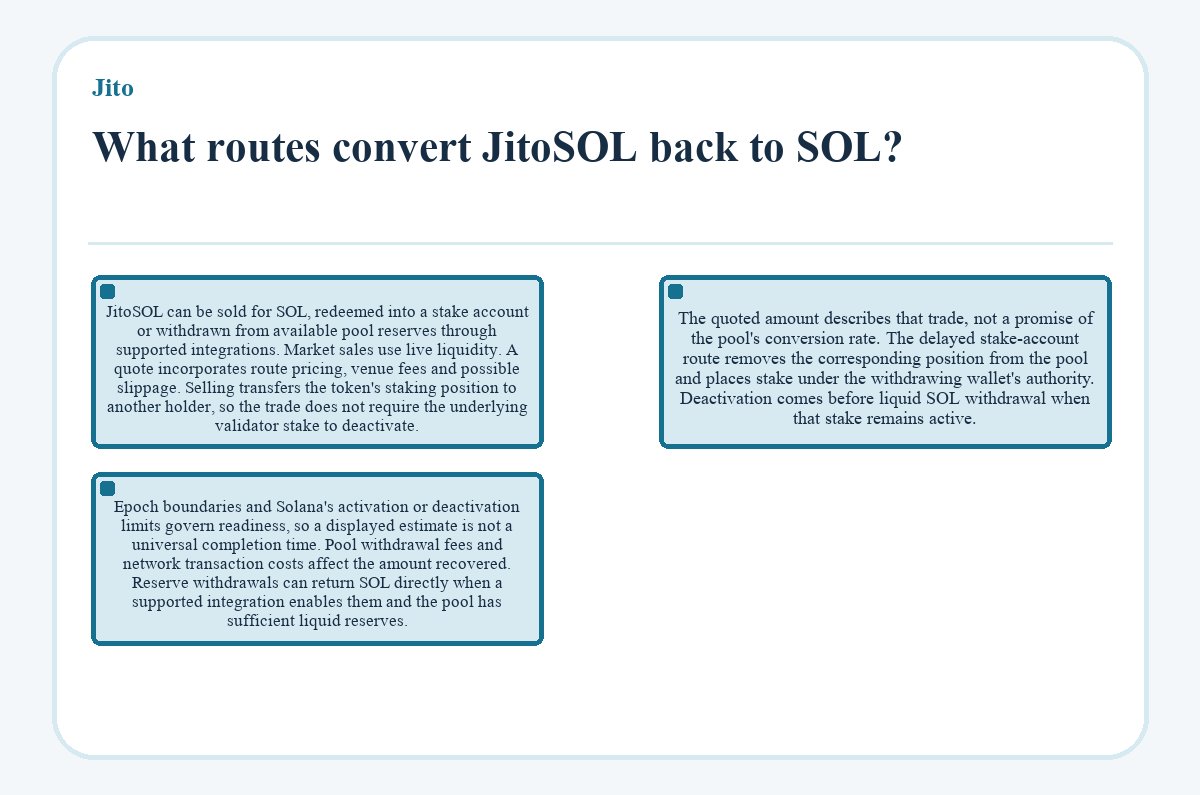
Reserve withdrawals can return SOL directly when a supported integration enables them and the pool has sufficient liquid reserves.
What does JTO control within Jito?
JTO enables participation in Jito DAO decisions covering protocol fees, delegation parameters and treasury management. These decisions affect infrastructure operations, including StakeNet and TipRouter settings. JTO has a different function from JitoSOL: the governance token supports voting participation, while the staking token represents a pool position. Proposals must pass the DAO's applicable governance process. Fee and delegation parameters can change, so past staking returns may reflect a different configuration.
Restaking vaults and network-specific obligations
Restaking connects eligible SPL tokens, including JitoSOL, with node consensus networks (NCNs) through vaults. Vaults issue vault receipt tokens (VRTs) and delegate stake to mutually approved operators. TipRouter uses an NCN to coordinate MEV tip distribution and priority-fee sharing by participating validators. Accepted assets, additional rewards and withdrawal conditions belong to the selected vault and network. Penalties can reduce vault assets when slashing is enabled under the network's rules. Vault withdrawal cooldowns can delay access to the deposited JitoSOL.
Common questions about Jito
Do I need JTO to stake SOL for JitoSOL?
JTO is not required to deposit SOL into the JitoSOL stake pool. The deposit uses SOL and the wallet authorization needed for that transaction. JTO serves a separate governance function. Buying the governance token does not create a JitoSOL staking position, and holding JitoSOL does not by itself supply JTO voting power.
Why can JitoSOL from a stake-account deposit be temporarily unavailable?
The standard Jito Interceptor flow holds JitoSOL from stake-account deposits for 10 hours. The position continues accruing staking and MEV rewards during that period. Automatic delivery after the holding period carries no Interceptor claim fee. Early claiming incurs a fee which declines with the remaining time. This hold applies to the stake-account deposit path, not ordinary SOL deposits or market swaps.
Can Solana transaction fees be paid from my JitoSOL balance?
Solana transaction fees are paid in SOL, so JitoSOL is not directly usable as the fee balance. The transaction's fee payer needs sufficient SOL for its base fee and any chosen priority fee. A sponsored transaction can name another fee payer, but the network still collects the fee in SOL.
What distinguishes genuine JitoSOL from a token with the same name?
The mint address identifies the token on Solana; its displayed name and logo do not establish identity. A lookalike with a different mint has a separate token supply and no automatic claim on the stake pool's SOL. A wallet's displayed price or recent-token listing does not establish pool backing. The mint selected for a swap must match the intended staking token.
Does a validator running Jito-Solana pass every MEV tip to delegators?
Validators can retain an MEV commission before tips reach delegators. Client use identifies an infrastructure capability, while the validator's commission and distribution arrangements determine its delegator share. Staking commission and MEV commission are separate cost inputs. A validator's advertised staking commission alone therefore does not describe how it splits MEV revenue.
Why does JitoSOL's displayed APY change?
JitoSOL's displayed annual percentage yield (APY) responds to changing staking returns and MEV income. Validator performance and commissions affect the staking portion. Auction income changes with transaction activity and profitable opportunities, including arbitrage and liquidations. A displayed percentage summarizes a rate of return; it does not specify the exact amount a particular holding will earn.
Can I cancel direct unstaking once it has begun?
Once withdrawal from the pool into a stake account executes, it cannot be canceled. The resulting stake account remains under the withdrawing wallet's authority. Liquid SOL still depends on deactivation and withdrawal if the stake remains active. Regaining a JitoSOL position requires a new eligible deposit or a market purchase.